Gearing up for a compliance audit can be a hair-raising experience, and no one will blame you for reaching for a bottle of antacids as the dreaded date approaches. There’s a lot to keep track of: you need to make sure that all your processes are up to date, well-documented, and that all the paperwork is in order. But that’s not all. Whether you’re preparing for an OSHA safety inspection, a surprise FDA visit, an ISO 9001 compliance tour, or a customer audit, your best strategy is deceptively simple: Expect the unexpected.
In the simplest terms, that means understanding that an auditor will not only want to see that you’ve done your homework, but that the processes you’re documenting are so well-integrated in your daily routine that anyone on the floor can clearly explain what you’re doing, and why. Being well-prepared for a deep dive into your training program will ensure a smooth audit process, and you’ll be able to go easy on the Tums.
Training records are often one of the first things that auditors want to see. “When brands send auditors to check our operations, they always zero in on two things,” said Eric Neuner of NuShoe in California. “Our inspection training documentation, and whether staff can actually demonstrate the procedures they were trained on.”
That level of scrutiny means the informal training methods that were enough to get you through audits in the past won’t cut it anymore. You need to invest the time and effort to make sure that a) everyone on the floor has been properly trained; b) the training has been properly documented; and c) and the employees who went through the training not only understand the documented processes but can clearly explain them to a visitor.
Unfortunately, auditors won’t go easy on you just because you’re running a small shop. Small companies face the same compliance expectations as large ones, even though they have fewer resources to work with. Training, which was once seen exclusively as an HR function, increasingly has become the responsibility of quality and risk-control teams. As a result, your QC and compliance leads must be skilled at training your staff. They may not feel prepared to take on that extra role, but it’s critical that they are able to step up and ensure employees are comfortable with the processes that you want to demonstrate to auditors.
The standards imposed by regulatory agencies, industry-based compliance organizations, and customers / suppliers have done a lot to shape how training is done and how it’s documented. Fortunately, there’s quite a bit of overlap between the different standards.
For example, ISO 45001 auditors have training requirements which, like the OSHA training requirements, focus on safety-related training and worker competency. FDA training requirements are more geared toward documented training and evidence of traceabilty. Customer and supplier audits tend to mirror those of the regulatory agencies.
Similarly, ISO 9001 training requirements demand competence and awareness of procedures, not just documented processes. Moosa Esfahnian of Dannico Woodworks in San Antonio, TX, said it best: “The inspector didn’t just ask to see training records. He went to the workshop floor, picked a worker at random, and asked them to walk through our quality check procedure for drawer glides – a point where safety and function are critical.”
Why the heightened interest in training? Auditors know that there’s a strong connection between gaps in training and gaps in quality. Training is also a critical component in incident investigations, recalls and corrective action. Moreover, a well-trained staff is proof that a company is really implementing its stated policies, not just documenting the procedures and filing them away.
The practices that companies normally employ to document their training regimen can be tricky: not just during the recording process, but at later stages, when those same documents need to be pulled up and referenced. Too often, companies fall back on old habits that seem to make sense in the moment, but which set them up for failure when the auditors knock on the door. Data is too often recorded on spreadsheets, shared folders, paper sign-off sheets, or other methods that are tracked inconsistently across departments or shifts.
Follow that path and you’re likely to find, at a critical moment while following the audit trail, that records are missing or outdated, or the evidence that training took place at all is murky. As Daniel Reynolds recalls, “During a UL field evaluation on a stadium wall, the inspector quizzed our lead on lockout-tagout. Passing hinged on dated sign-offs.”
To make matters worse, the audit prep process is made far more difficult when sloppy documentation is discovered, with countless person-hours wasted on correcting processes that weren’t properly documented in the first place.
You’re a good manager, but you’re only human, and sometimes it can feel like the auditors are working overtime to make your life difficult. They’re not – but they do have concrete expectations.
They want to see a clear linkage between job roles and the training required for those jobs. They expect documented evidence that training has been completed, that the training is consistent with current document revisions, and that those who received the training can competently carry out what they’ve learned.
They also will look for accessible records that can be retrieved quickly. If your documentation consists of spreadsheets or paper binders that are kept in one manager’s office in an offsite location, that’s a red flag.
Other red flags: training records that don’t carry dates or signatures, evidence that employees are being trained on obsolete procedures, a mismatch between the training required for a role and the training received, and records that include dates, but which indicate training is overdue.

There’s nothing scarier for a small manufacturer than discovering during audit prep that training records are spread across multiple spreadsheets and binders, or worse, that gaping holes exist in the data.
It’s a scenario that Ed Neuner of NuShoes would rather forget: “We learned the hard way back when we started handling quality correction work for factories. One of our first big contracts involved fixing finish defects on 50,000 pairs, and the brand’s auditor showed up unannounced. They asked our lead tech about color consistency standards, and while he knew the work cold, we couldn’t produce his training certificate for that specific brand’s specs. We had to halt that entire batch until we documented his training properly – cost us three days and nearly lost the contract.”
A more structured training approach, Ed learned, leads to clearer evidence, fewer findings, and less disruption. Not to mention fewer sleepless nights.
Getting your training program documentation audit-ready doesn’t require superhuman effort or eye-popping technology. Rather, your company’s goal should be clarity – tracking who received which training for which role, and how you can demonstrate that to anyone who cares to look.
That said, many manufacturers choose cost-effective apps that can help with issues such as
spreadsheets and paper records that might be inadequate as a company grows.
keeping track of retraining requirements as protocols change.
the administrative burden of manual follow-ups and reminders, which can lead to training gaps and lack of proper documentation.
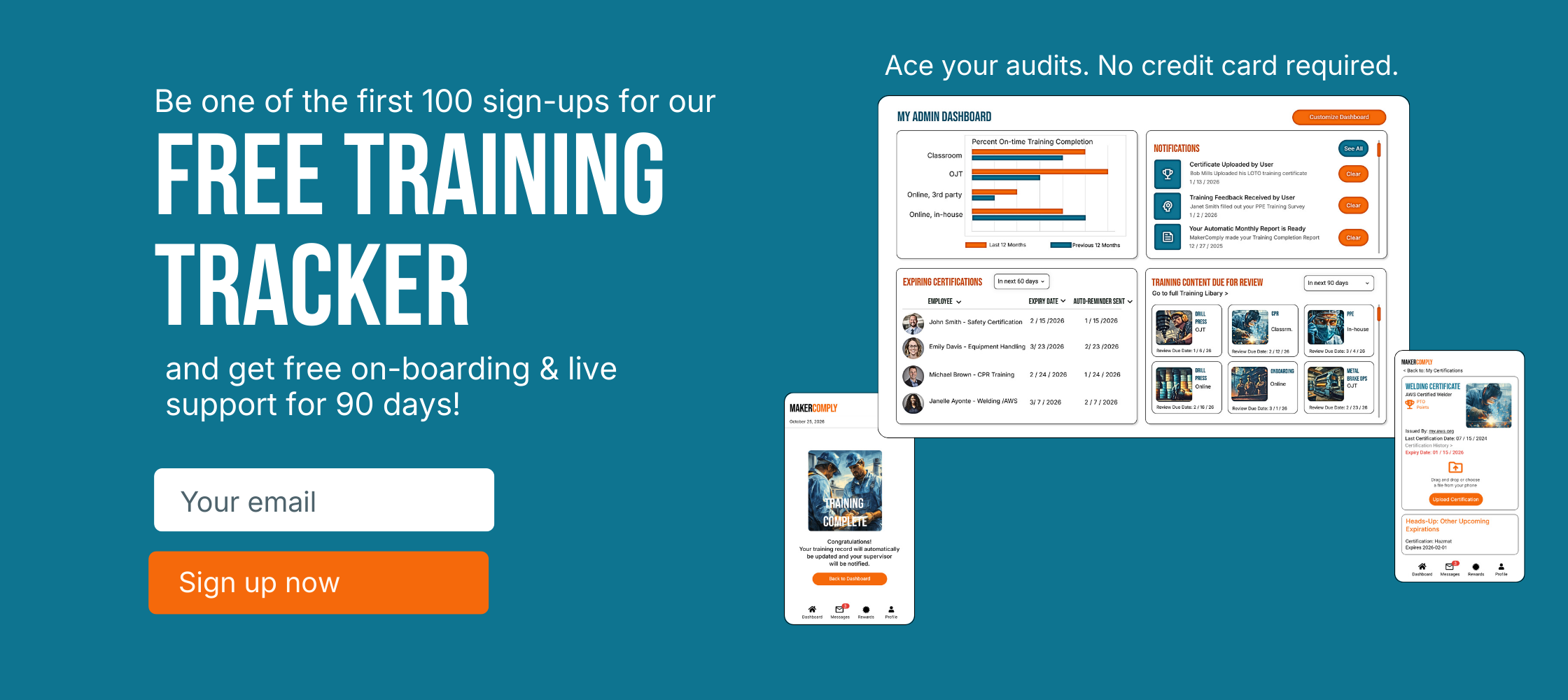
Many small manufacturers these days switch to training management software or competency management software to improve visibility across departments, make the audit trail easier to follow, and to make demonstrating compliance during inspections easy – as easy as pulling out a tablet on the manufacturing floor and showing the data on a digital screen.
Keeping careful track of your training program will help get you through that nerve-wracking audit, but there’s an added benefit. Building a structured, well-documented training system will reduce risk, improve consistency and make it easier for your manufacturing business to grow in the future.
Training compliance is not about checking boxes; it is about improving operations and staving off a multiplicity of risks. Alfred Christ at ROKR sums it up: “When your workforce is well-trained, it helps to eliminate mistakes, brings down the probability of accidents at work, and guarantees that the output of the plant conforms to both the internal quality standards and the statutory requirements, thus making audit-readiness easier and more effective in terms of time and resources.”