Research shows 94% of spreadsheets contain errors1, leading to record discrepancies and faulty decisions. In manufacturing, a simple logging error can result in an employee being incorrectly marked as qualified (or not), with real shop-floor consequences.
Your training program looks perfect on paper. Until it doesn't. A forklift operator you thought was certified hasn't actually completed refresher training in 18 months. But three different spreadsheets may say otherwise.
In manufacturing, the gap between "trained" and "probably trained" can cost you $165,514 per violation2. Missing or outdated training records during an inspection can trigger these penalties. Beyond OSHA, customers and auditors increasingly demand proof that workers are trained and certified.
The volume is substantial. One manufacturing manager described tracking certifications for "400 employees across 3 locations"– roughly "60,000 potential training events" and calling it "challenging."
A typical manufacturer trains each employee on ~12 safety topics per year (PPE, Hazard Communication, Lockout/Tagout, etc.). For 50–200 employees, that's 500–2,000 training records annually, before adding new hires, role changes, or incident-driven refreshers.
OSHA requires detailed records for each session: date, training content, trainer's name and qualifications, and attendee names and job titles. These records pile up quickly, and OSHA can demand them within 4 business hours. Imagine scrambling if your logs are scattered across spreadsheets or buried in filing cabinets.
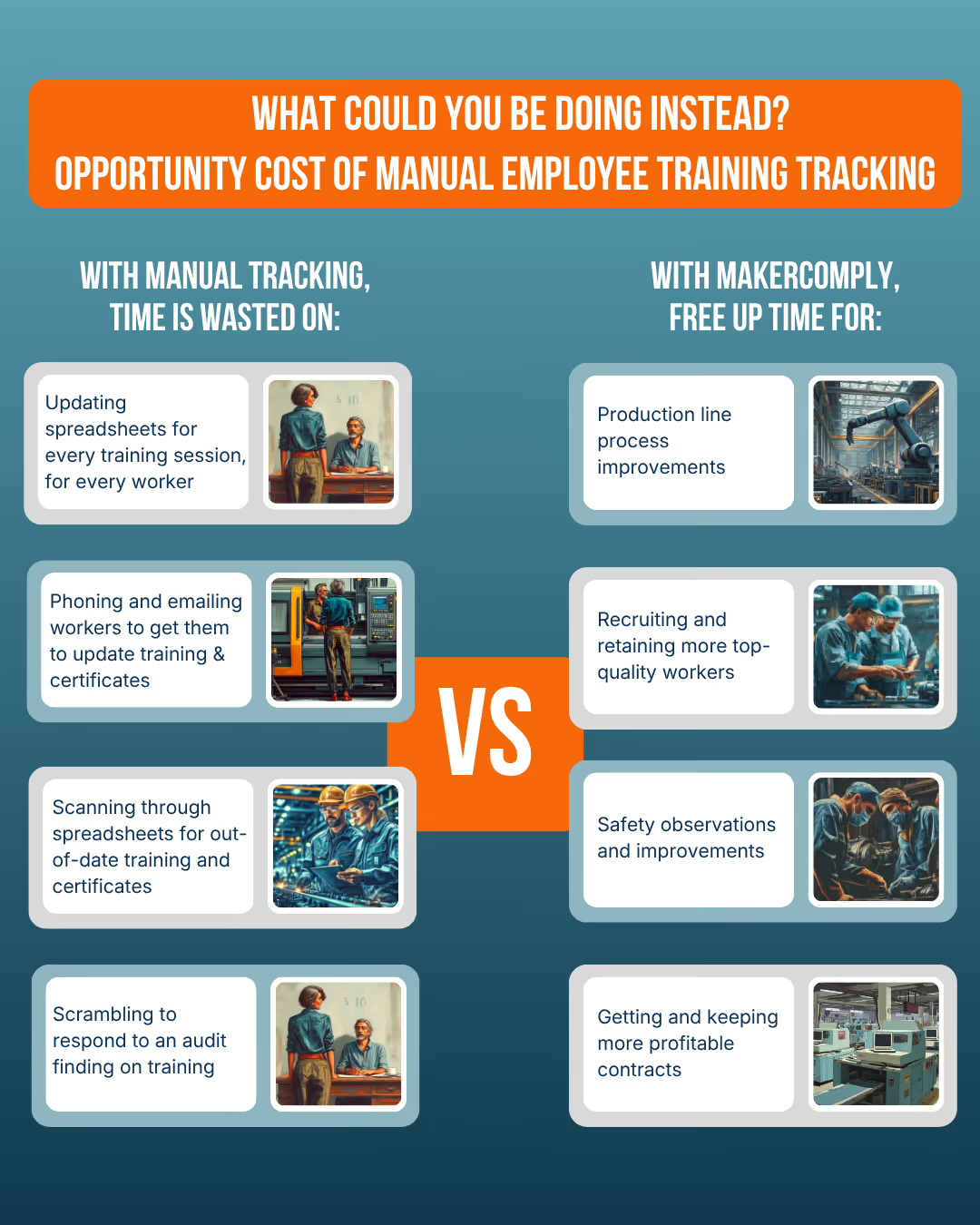
Manual tracking consumes disproportionate administrative time. Updating training logs falls on managers, safety officers, or QA staff who already wear multiple hats.
Consider this common scenario: A plant manager filters the spreadsheet monthly for expiring qualifications, then emails each worker individually. When workers don't complete training, he sends follow-ups, makes phone calls, requests certificates (multiple times), manually uploads files, finds the latest spreadsheet version, and updates the completion date.
This cycle takes two months. In nine months, it starts again. Multiply this by every training and certification for every employee.
Because spreadsheets lack automation, managers must continually check them. If forgotten, certifications lapse. Multiple departments often duplicate efforts (HR keeps onboarding files, EHS coordinates OSHA trainings, and production maintains skills matrices). Without centralization, the same data gets entered multiple times.
Compliance teams report spending up to 12 hours weekly3 on manual compliance administration. Every hour updating spreadsheets is an hour not spent on value-adding work like optimizing production or mentoring employees.
Training that isn't properly tracked can be as costly as no training at all. If certification expires or completion wasn't logged correctly, it creates chaos.
Imagine a forklift operator's OSHA certification expired last month. That operator must be pulled from the job until recertification. Production has stalled due to a certification slip-up.
Worse is when an unqualified worker isn't caught in time. If a noncertified forklift driver has an accident, investigators immediately verify the driver's training status. If certification isn't current, the company faces liability as if no training was provided, leading to lawsuits, compensation claims, and fines.
From a safety culture perspective, running with lapsed certifications sends a message that compliance is lax. A well-trained, properly documented workforce is safer with fewer accidents.
Training records are frequent flashpoints in audits. Whether OSHA, ISO, customer quality, or insurance underwriters, missing documentation raises red flags.
Beyond OSHA's six-figure fines, customer audits pose major concerns. In automotive, aerospace, or government contracts, auditors perform spot checks. If you can't produce current training files, it undermines confidence. One major non-conformance can trigger contract termination or loss of preferred supplier status.
Insurance companies examine training documentation during risk assessments. Poor documentation signals a higher risk, resulting in higher premiums or limited coverage. Demonstrating strong training management can earn 2–5% premium credits, while OSHA violations can trigger surcharges of 20-50%.4 Over several years, that difference amounts to tens of thousands in insurance costs.
EPA requirements for hazardous materials also mandate employee training records. Gaps can provoke additional investigations. Similarly, FDA training requirements for medical device and pharmaceutical manufacturers mandate comprehensive documentation of employee competencies and training records.
One lumber company invested $50,000 in training and safety processes5 through OSHA's SHARP program and saved more than $1 million over five years, reducing insurance premiums by 75%.
ISO 9001 training requirements require evidence of employee competence. Auditors won't take your word. They'll ask for proof.
Beyond direct labor and risk impacts, there's opportunity cost: what you could be doing if you weren't maintaining spreadsheets.
Continuous improvement projects get shelved because the compliance admin consumes too much time. If quality managers and safety officers weren't chasing certificates or preparing audit binders, they'd be conducting safety observations, running lean events, or refining processes to reduce defects.
Manual tracking also impacts responsiveness. When new regulations or customer requirements emerge, companies using manual systems respond more slowly. Automated systems pull lists in seconds.
Spreadsheets lack automatic revision history, approval workflows, and audit trails. As one expert noted6, "The primary failing of a spreadsheet is its lack of an immutable audit trail. Any cell can be changed by anyone with access, with no unalterable record of who made the change, what was changed, and when." You can't easily identify trends or accountability over time.
Manual drudgery erodes culture. Employees who spend time on low-value admin tasks feel underutilized. Those who are constantly bombarded by emails view compliance as a chore rather than as integral to safety culture.
Manual tracking imposes opportunity cost by diverting focus from improvement to maintenance. Training management software frees up administrative time, allowing reinvestment in safety, quality, and efficiency programs that drive the company forward.
Software costs should be weighed against labor savings, risk avoidance, and operational benefits. For small and midsize manufacturers, the math strongly favors switching to software once all factors are considered.
Here are some key ROI components:
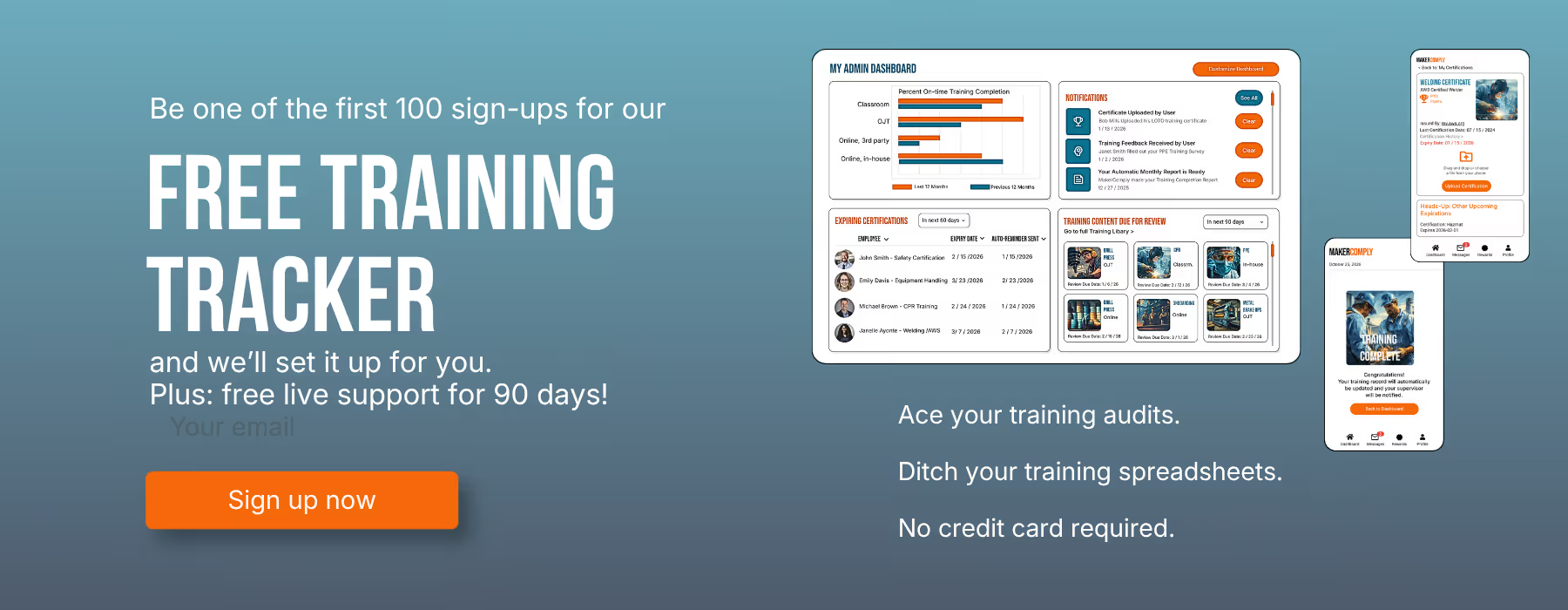
If you spend $87,000 annually training 100 employees, administrative overhead adds ~$20,000. A training tracking system costing as little as MakerComply's solution annually that cuts overhead in half and prevents one moderate fine delivers rapid positive ROI. If you're after immediate ROI and just need to get better control over training scheduling, start with MakerComply's Free Training Tracker and cut your time to manage training to less than an hour a week.
Focus on tools designed for tracking, not bloated Learning Management Systems with unused features. Enterprise LMS platforms built for large corporations can carry high fees and extensive setup that eatsinto ROI. Lean, purpose-built tracking tools onboard quickly anddeliver returns faster.
For small and midsized manufacturers, practical features and ease ofuse should take priority:
Take advantage of free trials or freemium versions, like this Free Training Tracker. Have the people managing training records test it. The ideal system should feel like relief.
For too long, training compliance has been viewed as something you handle with a sign-in sheet and a filing cabinet. But manual tracking siphons management time, invites costly errors, and increases compliance risks that can materially hurt your business. These hidden costs don't show up on budget line items, but they're real (in missed production, audit penalties, and employee turnover).
Once you quantify the hours lost and the risks of sticking to spreadsheets, the value of a purpose-built solution becomes clear. Modern training tracking systems are risk management and productivity tools that move you from reactive scrambling to proactive assurance, preventing $100,000+ OSHA fines and line shutdowns.
Moreover, efficient training management lets you focus on improving training quality and workforce skills rather than pushing paperwork. The software handles timely delivery and proper recording, so you concentrate on content and outcomes.
Every untracked training or missed renewal is a potential failure to protect employees and the business. Well-trained workforces that you can prove are well-trained are competitive advantages, i.e., fewer accidents, higher productivity, and easier contract wins.
With labor tight and safety expectations higher than ever, you can't afford gaps in your training records. But get it right, and you've got a real competitive edge: fewer accidents, smoother operations, and the credibility that comes from proving your people know what they're doing.
Sources:
Research shows 88% of spreadsheets contain errors1, leading to record discrepancies and faulty decisions. In manufacturing, a simple logging error can result in an employee being incorrectly marked as qualified (or not), with real shop-floor consequences.
Your training program looks perfect on paper. Until it doesn't. A forklift operator you thought was certified hasn't actually completed refresher training in 18 months. But three different spreadsheets may say otherwise.
In manufacturing, the gap between "trained" and "probably trained" can cost you $165,514 per violation2. Missing or outdated training records during an inspection can trigger these penalties. Beyond OSHA, customers and auditors increasingly demand proof that workers are trained and certified.
The volume is substantial. One manufacturing manager described tracking certifications for "400 employees across 3 locations"– roughly "60,000 potential training events" and calling it "challenging."
A typical manufacturer trains each employee on ~12 safety topics per year (PPE, Hazard Communication, Lockout/Tagout, etc.). For 50–200 employees, that's 500–2,000 training records annually, before adding new hires, role changes, or incident-driven refreshers.
OSHA requires detailed records for each session: date, training content, trainer's name and qualifications, and attendee names and job titles. These records pile up quickly, and OSHA can demand them within 4 business hours. Imagine scrambling if your logs are scattered across spreadsheets or buried in filing cabinets.

Manual tracking consumes disproportionate administrative time. Updating training logs falls on managers, HR, safety officers, or QA staff who already wear multiple hats.
Consider this common scenario: A plant manager filters the spreadsheet monthly for expiring qualifications, then emails each worker individually. When workers don't complete training, he sends follow-ups, makes phone calls, requests certificates (multiple times), manually uploads files, finds the latest spreadsheet version, and updates the completion date.
This cycle takes two months. In nine months, it starts again. Multiply this by every training and certification for every employee.
Because spreadsheets lack automation, managers must continually check them. If forgotten, certifications lapse. Multiple departments often duplicate efforts (HR keeps onboarding files, EHS coordinates OSHA trainings, and production maintains skills matrices). Without centralization, the same data gets entered multiple times.
Compliance teams report spending up to 12 hours weekly3 on manual compliance administration. Every hour updating spreadsheets is an hour not spent on value-adding work like optimizing production or mentoring employees.
Training that isn't properly tracked can be as costly as no training at all. If certification expires or completion wasn't logged correctly, it creates chaos.
Imagine a forklift operator's OSHA certification expired last month. That operator must be pulled from the job until recertification. Production has stalled due to a certification slip-up.
Worse is when an unqualified worker isn't caught in time. If a noncertified forklift driver has an accident, investigators immediately verify the driver's training status. If certification isn't current, the company faces liability as if no training was provided, leading to lawsuits, compensation claims, and fines.
From a safety culture perspective, running with lapsed certifications sends a message that compliance is lax. A well-trained, properly documented workforce is safer with fewer accidents.
Training records are frequent flashpoints in audits. Whether OSHA,ISO, customer quality, or insurance underwriters, missing documentation raises red flags.
Beyond OSHA's six-figure fines, customer audits pose major concerns. In automotive, aerospace, or government contracts, auditors perform spot checks. If you can't produce current training files, it undermines confidence. One major non-conformance can trigger contract termination or loss of preferred supplier status.
Insurance companies examine training documentation during risk assessments. Poor documentation signals a higher risk, resulting in higher premiums or limited coverage. Demonstrating strong training management can earn 2–5% premium credits, while OSHA violations can trigger surcharges of 20-50%.4 Over several years, that difference amounts to tens of thousands in insurance costs.
EPA requirements for hazardous materials also mandate employee training records. Gaps can provoke additional investigations. Similarly, FDA training requirements for medical device and pharmaceutical manufacturers mandate comprehensive documentation of employee competencies and training records.
One lumber company invested $50,000 in training and safety processes5 through OSHA's SHARP program and saved more than $1 million over five years, reducing insurance premiums by 75%.
ISO 9001 training requirements require evidence of employee competence. Auditors won't take your word. They'll ask for proof.
Beyond direct labor and risk impacts, there's opportunity cost: what you could be doing if you weren't maintaining spreadsheets.
Continuous improvement projects get shelved because the compliance admin consumes too much time. If quality managers and safety officers weren't chasing certificates or preparing audit binders, they'd be conducting safety observations, running lean events, or refining processes to reduce defects.
Manual tracking also impacts responsiveness. When new regulations or customer requirements emerge, companies using manual systems respond more slowly. Automated systems pull lists in seconds.
Spreadsheets lack automatic revision history, approval workflows, and audit trails. As one expert noted6, "The primary failing of a spreadsheet is its lack of an immutable audit trail. Any cell can be changed by anyone with access, with no unalterable record of who made the change, what was changed, and when." You can't easily identify trends or accountability over time.
Manual drudgery erodes culture. Employees who spend time on low-value admin tasks feel underutilized. Those who are constantly bombarded by emails view compliance as a chore rather than as integral to safety culture.
Manual tracking imposes opportunity cost by diverting focus from improvement to maintenance. Training management software frees up administrative time, allowing reinvestment in safety, quality, and efficiency programs that drive the company forward.
Software costs should be weighed against labor savings, risk avoidance, and operational benefits. For small and midsize manufacturers, the math strongly favors switching to software once all factors are considered.
Here are some key ROI components:
If you spend $87,000 annually training 100 employees, administrative overhead adds ~$20,000. A training tracking system costing as little as MakerComply's solution annually that cuts overhead in half and prevents one moderate fine delivers rapid positive ROI. If you're after immediate ROI and just need to get better control over training scheduling, start with MakerComply's Free Training Tracker and cut your time to manage training to less than an hour a week.
Focus on tools designed for tracking, not bloated Learning Management Systems with unused features. Enterprise LMS platforms built for large corporations can carry high fees and extensive setup that eatsinto ROI. Lean, purpose-built tracking tools onboard quickly anddeliver returns faster.
For small and midsized manufacturers, practical features and ease ofuse should take priority:
Take advantage of free trials or freemium versions, like this Free Training Tracker. Have the people managing training records test it. The ideal system should feel like relief.
For too long, training compliance has been viewed as something you handle with a sign-in sheet and a filing cabinet. But manual tracking siphons management time, invites costly errors, and increases compliance risks that can materially hurt your business. These hidden costs don't show up on budget line items, but they're real (in missed production, audit penalties, and employee turnover).
Once you quantify the hours lost and the risks of sticking to spreadsheets, the value of a purpose-built solution becomes clear. Modern training tracking systems are risk management and productivity tools that move you from reactive scrambling to proactive assurance, preventing $100,000+ OSHA fines and line shutdowns.
Moreover, efficient training management lets you focus on improving training quality and workforce skills rather than pushing paperwork. The software handles timely delivery and proper recording, so you concentrate on content and outcomes.
Every untracked training or missed renewal is a potential failure to protect employees and the business. Well-trained workforces that you can prove are well-trained are competitive advantages, i.e., fewer accidents, higher productivity, and easier contract wins.
With labor tight and safety expectations higher than ever, you can't afford gaps in your training records. But get it right, and you've got a real competitive edge: fewer accidents, smoother operations, and the credibility that comes from proving your people know what they're doing.
Sources: